
Why Only 2.7% of HVAC Technicians Are Women and How Shops Can Change That
Ask someone to name an innovative industry and they may mention aerospace, electric vehicles or AI. Heating and cooling rarely comes up, even though it keeps nearly every home and business running.
That perception costs the industry in terms of hiring. People who don’t view HVAC as a place to build a career likely won’t apply. In our recent look at why America needs to fill 40,000+ HVAC job openings a year, MRCOOL asked what would happen if the industry put as much energy into developing technicians as it puts into chasing them. Women are one of the largest pools of talent available to the HVAC industry, but the number of women in HVAC jobs is slim.
The Quick Answer
Just a tiny portion of HVAC mechanics and installers in the U.S. are women. Shops that want to increase that number should examine it as an operations goal. Transparent job posts, practical training paths, gear that fits, structured mentorships and a learning-focused culture are all integral to the job. The benefits of hiring women are immediate and can impact the future of HVAC by utilizing previously untapped innovative design and leadership perspectives.
How Many Women Work in HVAC?
According to The HVAC Brief, women held 2.7% of heating, air conditioning and refrigeration mechanic and installer jobs in 2025. Women make up 47.1% percent of the entire U.S. workforce. For a clearer picture of the issue, the HVAC trade hires almost entirely from only half the U.S. population then scrambles every July when the phones won't stop ringing. That gap is a capacity problem. When qualified women never consider a career in HVAC, it results in another delayed service call and could be the difference between a homeowner having AC or not.
Why Women in HVAC Is an Innovation Question
MRCOOL asked if heating and cooling could be designed around people. That investigative process resulted in the MRCOOL® DIY® ductless mini-split and patented Quick Connect® technology, which removed the complexity that had prevented homeowners from installing their own systems.

Apply the same innovative approach to the workforce and a new question appears. What if the industry adapted to the available talent? Women can help determine the future of HVAC.
Every breakthrough begins with identifying a problem. How could installation get easier? How can a heat pump perform effectively in extreme cold? How should AI support a technician's judgment without replacing it? How do we design equipment that’s easier for contractors and homeowners to understand?
As HVAC moves toward smarter equipment, new refrigerants, electrification and connected systems, expanding the circle of people who design, install and improve that technology becomes an innovation strategy. Involving people with different experiences increases the likelihood of identifying different beliefs and frustrations, and encourages sharing new ideas.
HVAC Careers for Women Reach Beyond Field Work
Public perception of HVAC is years behind the industry itself. Field work is hands-on and physically demanding, and that won't change. Technicians currently work with variable-speed heat pumps, inverter technology, electronic diagnostics, smart controls and A2L refrigerants. Success in an HVAC career requires mechanical reasoning, electrical knowledge and the ability to explain a problem clearly to a homeowner.
Keep in mind HVAC includes a whole industry of careers:
Engineers designing the next generation of heat pumps
Product development teams testing new ideas
Manufacturing specialists improving how equipment gets built
Trainers and educators preparing technicians for rapidly-changing technology
Controls and connected-systems specialists
Sales, distribution and operations leaders
Contractors, business owners and executives
ACHR News' Top Women in HVAC recognition demonstrates that range of careers, and honors the women in field service, leadership, business ownership, engineering, education and sales positions.
The greatest opportunity is helping more women build long-term careers in HVAC once they enter the workforce.
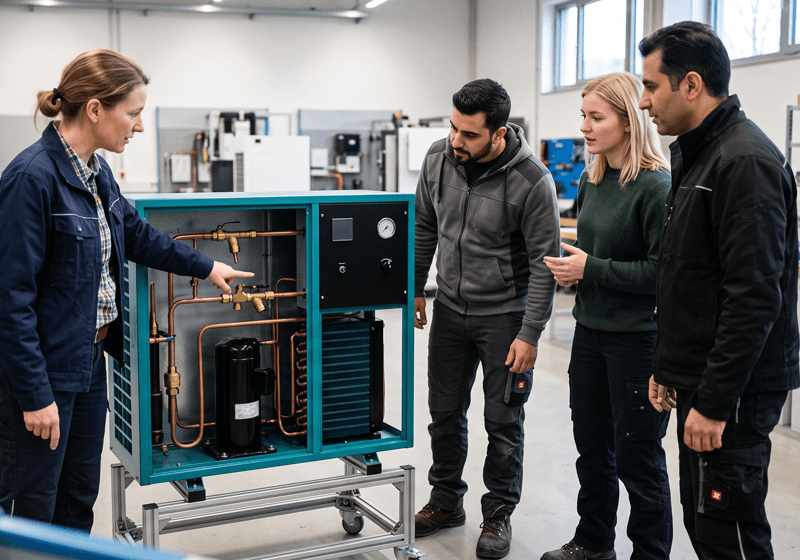 A strong HVAC path model follows the full arc of a career.
Discover → Enter → Stay → Advance → Lead
Here's what each stage looks like in more detail.
Discover by Sharing the Work
Nobody chooses a career they've never heard of or one that looks miserable. If HVAC only appears as sweaty attic work, many potential technicians, engineers and owners will avoid it.
Visibility starts with the job post. "Must hit the ground running" tells a candidate nothing about the work and filters out capable people before anyone asks questions. A better post presents the real work, explains the training process and shows where the job leads.
Strong job posts often include details like these.
Install support alongside a lead technician
Structured training on ductless, heat pump and central systems
Documented milestones for field readiness
Clear expectations for safety, customer communication and paperwork
The job doesn't need to sound easier. The path needs to be clearer. Skip "We need women in HVAC." Try "Look at what you could build here."
Enter Through Multiple Routes
Shops that recruit only through friend-of-a-friend referrals will limit themselves to a narrow pipeline of talent.
Trade schools, community colleges, CTE programs, apprenticeships and local workforce groups that support women in nontraditional fields can produce candidates who may never answer a generic ad. The U.S. Department of Labor's Women in Apprenticeship and Nontraditional Occupations (WANTO) grant program funds community groups that help employers recruit, train and retain women in skilled trade roles.
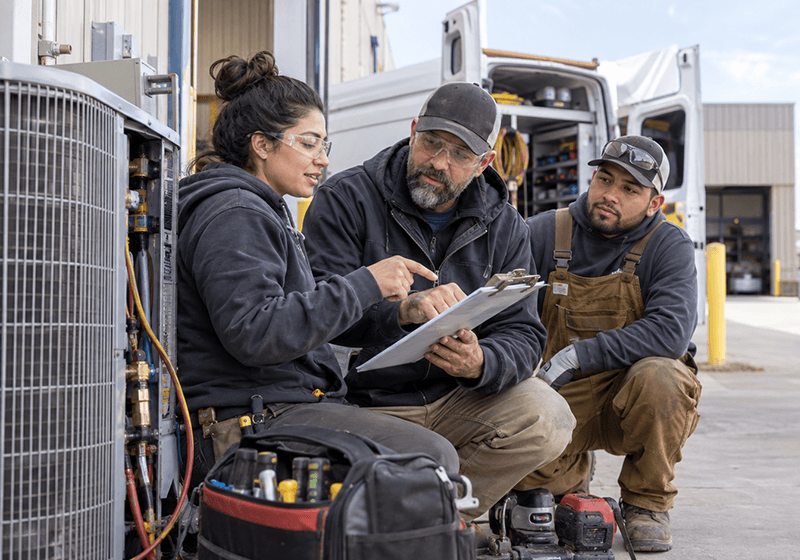
The Department's research on apprenticeship as a tool to improve diversity in construction reveals this program as one of the clearest paths into the trade. In several skilled trades, women represent a higher percentage of active apprentices than of the overall workforce.
Stay by Fixing the Friction
A shop that wants more women should start with day one. What does a new hire actually see when she walks in?
Is there a clean bathroom and somewhere to change? Do uniforms and PPE come in sizes she can wear? Does the crew know she's starting? Does someone manage her training? When she asks a basic question, does she get an answer or an eye roll?
That's the valid culture test. First impressions rarely feel dramatic, but they pile up one moment at a time. Consideration and the adequate management of these experiences indicates competent onboarding, and every new hire benefits.
These friction points quietly increase attrition rates.
PPE or uniforms that don't fit
No clear mentor or training manager
Jobsite "jokes" that create consistent discomfort for people
Months assigned to low-value support tasks
Being judged on confidence over progress
Fuzzy lines between solo work and supervised work
Some shops dismiss these roadblocks as soft issues, forcing new technicians to choose between mastering their skills in areas like airflow and wiring, while also navigating workplace politics.
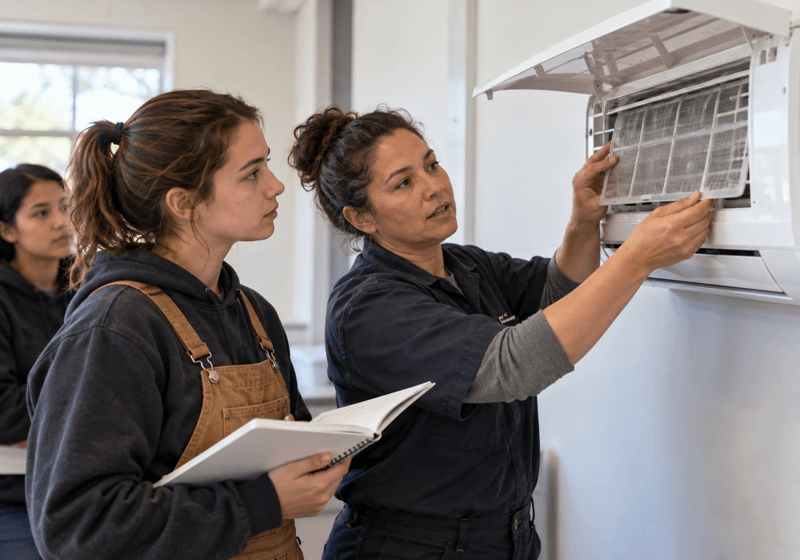 Advance With Mentorship That Has Structure
Mentorship changes careers and builds leaders, which is why Women in HVACR has designed integral mentorship, scholarship and ambassador programs.
Inside a shop, mentorship only succeeds within a supportive system. One patient senior tech can't fix chaos alone. Without a documented skill ladder, approvals and consistent expectations, the mentor ends up with an overwhelming amount of responsibility.
A stronger program takes five steps.
Assign a real training manager
Define the initial tasks a new tech can handle
Identify what requires direct supervision
Review progress on a set schedule
Coach communication practice along with technical skill
That fifth step matters. A mechanically adept tech can quickly lose a homeowner's trust if she can't explain what she checked, the fixes needed and next steps in the process.
Advancement has to be visible too. Continuing education, certifications, professional networks and a clear view of their next role informs her she's building a career.
Lead by Counting Promotions Alongside Hires
Success looks like a technician becoming a supervisor. An apprentice becoming a trainer. An engineer becoming a product leader. A contractor becoming an owner. Eventually the new hire becomes the person showing someone else what's possible.
Sometimes it looks like a tech spotting a problem in the field that later changes product design. Industries evolve that way.
How HVAC Manufacturers Can Help
Manufacturers can't replace good management, but they can help shorten the learning curve.
Innovative new technologies play a big role. When equipment removes unnecessary steps, newer technicians spend less time dealing with operational issues and more time building the judgment that makes them valuable. That idea drives advancements, like MRCOOL's patented Pre-Charged Quick Connect® Line Sets.
Clear documentation and responsive support matter just as much. If your team installs or services MRCOOL equipment, make sure every new hire knows where to find these resources.
Training a new hire is one of the biggest investments a shop makes, and the clock starts the day she walks in," said Jason Ingram, MRCOOL chief executive officer and managing member. "Equipment that requires fewer steps to install helps her start working sooner and allows your senior techs more time to coach instead of correct.
Is Your Shop Ready?
This approach works best for shops and leaders like these.
Shops that want an expanded talent pipeline and will strengthen onboarding to get it
Contractors growing ductless, heat pump or mixed install and service teams
Owners who know retention starts before the first solo call
Managers willing to standardize expectations and share knowledge
It tends to fail in places like these.
Shops chasing the appearance of inclusion with no change to daily operations
Teams with no training manager and no patience for questions
Companies that still equate "field ready" with "thrown in quickly"
Workplaces that treat low-level disrespect as normal trade culture
Four Things to Do This Month
You don't need to rebuild the company.
Rewrite one job post in plain language that identifies the work, the training and the path.
Walk your shop as a new hire would. Check uniforms, PPE and facilities for obvious friction.
Assign one training manager and document what a new tech can handle in their first month.
Build one relationship outside your usual network, such as a trade school, an apprenticeship program or a local Women in HVACR chapter.
Strong crews grow from a hundred small operational choices that make the job more teachable, increasingly predictable and make employees feel valued.
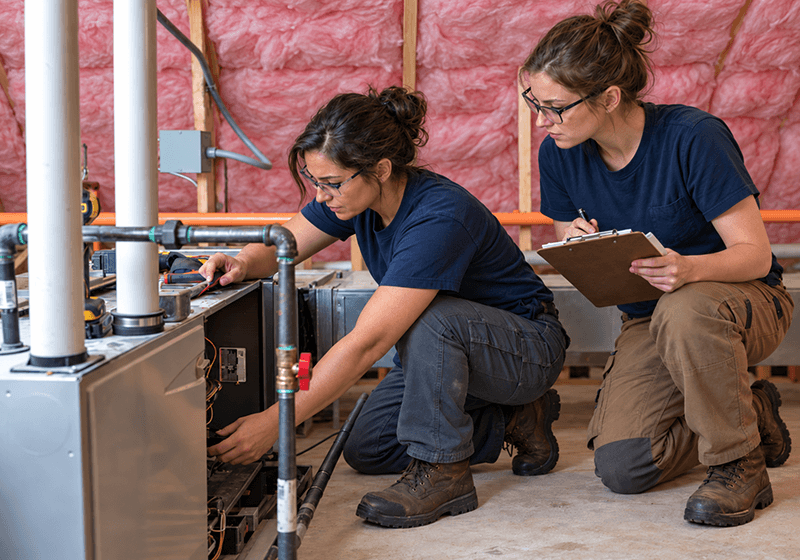
Who Will Build What's Next in HVAC?
Women held just 2.7% of HVAC mechanic and installer jobs in 2025. Growing that number is important. The overarching goal is to revise who is able to see themselves in this industry and provide the training, technology, mentorship and opportunity to build a career in it.
The new outlook opens doors for high school students, those looking to make a career switch, veterans and entrepreneurs. HVAC needs more workers, in addition to innovators. So the question goes beyond who will fill the next 40,600 openings, and instead asks who will invent, manufacture, install, improve and lead what comes after them.
Nobody needs permission to belong in HVAC," said Bonnie Clymer, MRCOOL chief marketing officer. "The women already working in the industry as engineers, owners and leaders continually change the status quo by asking ‘Why not?’ Whether they’re in high school classrooms or considering a career change, this field needs what the next generation will bring.
Expanding the landscape of who builds the future of comfort may be how heating and cooling finally lands at the top of someone’s innovative industries list.
Frequently Asked Questions About Women in HVAC Careers
What percentage of HVAC technicians are women?
Women held 2.7% of U.S. heating, air conditioning and refrigeration mechanic and installer jobs in 2025, according to the U.S. Bureau of Labor Statistics Current Population Survey. That equals roughly 15,000 women in a field of about 561,000 workers. Women make up 47.1% of the total U.S. workforce, placing HVAC among the least gender-diverse skilled trades.
Is HVAC a good career for women?
Yes. HVAC offers strong job demand, solid pay and career paths that extend from field service into engineering, training, sales and business ownership. The Bureau of Labor Statistics projects about 40,600 openings for HVAC mechanics and installers each year through 2035. Many of those openings come from workers who retire or move to other occupations. Employment in the field is projected to grow 11%, much faster than the occupational average. The median annual wage was $61,010 in May 2025.
Is HVAC work too physically demanding for women?
No. HVAC field work involves lifting, climbing, cramped spaces and extreme temperatures, and those demands apply to every technician. Proper lifting technique, team lifts, the right tools and well-fitting PPE reduce injury risk. Mechanical reasoning, electrical knowledge and clear customer communication impact safety. MRCOOL innovation continues to reduce the physical burdens of the work. Learn how patented Quick Connect® Line Sets simplify installation.
What is Women in HVACR?
Women in HVACR is a nonprofit organization founded in 2002 to support women working in heating, ventilation, air conditioning and refrigeration. The group has about 1,200 members and offers networking events, the Navigator mentorship program, a regional ambassador program and annual scholarships for women entering the industry.
How can HVAC companies recruit more women?
HVAC companies can gain the interest of more women by creating job posts that describe the actual work, the training and the career path, then building relationships with trade schools, apprenticeship programs and groups like Women in HVACR. Recruiting pays off long term only when effective onboarding, properly fitted gear and structured mentorship reinforce the message.
Why do women leave HVAC jobs?
Women leave HVAC jobs due to a variety of obstacles. Poorly fitting PPE and uniforms, lack of an assigned mentor, isolation on the crew and jobsite "jokes" that wear people down are common examples. Unclear expectations and months assigned to low-value tasks also contribute to increased early attrition rates.
What HVAC careers are available to women outside of field service?
Women work in HVAC as engineers, product developers, manufacturing specialists, controls and connected-systems specialists, trainers, instructors, sales and distribution professionals, operations leaders, marketing professionals and business owners. The work performed by many of these roles shapes the equipment and tools routinely used by field technicians. Check out creative HVAC careers.
Sources: