
Some summers you remember by the heat. This one, Noah Shaw (@fordsixfo) will remember by who he helped get through it.
This summer, Noah completed two MRCOOL® DIY® 5th Generation Mini-Split installations in the Texas Hill Country: an emergency replacement at a solar-powered, off-grid home in Medina, and a donated three-system installation at a community fellowship center in Bandera. Both projects demonstrate how ductless mini-splits can provide efficient heating and cooling in spaces where conventional HVAC installation may be difficult or expensive.
Key Takeaways
- Noah Shaw installed a MRCOOL® DIY® 5th Generation Mini-Split at an off-grid, solar-powered home in Medina, Texas.
- The replacement was completed within hours during temperatures exceeding 100°F.
- The home's solar-only power supply made HVAC efficiency especially important.
- Noah later installed three 36,000 BTU DIY® systems at a community fellowship center in Bandera.
- Pre-charged Quick Connect® line sets eliminate the need to vacuum or braze refrigerant lines during installation.
Off-Grid Mini-Split Installation in Medina, Texas
The first call couldn't wait for scheduling. Noah's friend Matthew's AC had gone out, and Matthew’s home isn't easy to reach. He and his family (his wife and two young daughters) live up a rough hill road in Medina, a Hill Country town with a population of only a couple hundred people. It's remote enough that there's no power grid access at all. Matthew's home runs entirely on solar, with water pumped up from the river and filtered on site.
With daily highs climbing past 100 degrees, going without AC wasn't something the family could just wait out, especially not in their bedroom. Noah, who estimates he has installed more than 15 MRCOOL® DIY® systems, knew the installation process well enough to move quickly when Matthew's AC failed. The pair coordinated quickly, loaded up a MRCOOL® DIY® 9K 5th-Gen, and made the 20-minute ride in Noah’s helicopter. They arrived at the house, unloaded, and had the old unit swapped for the new one within a couple hours.
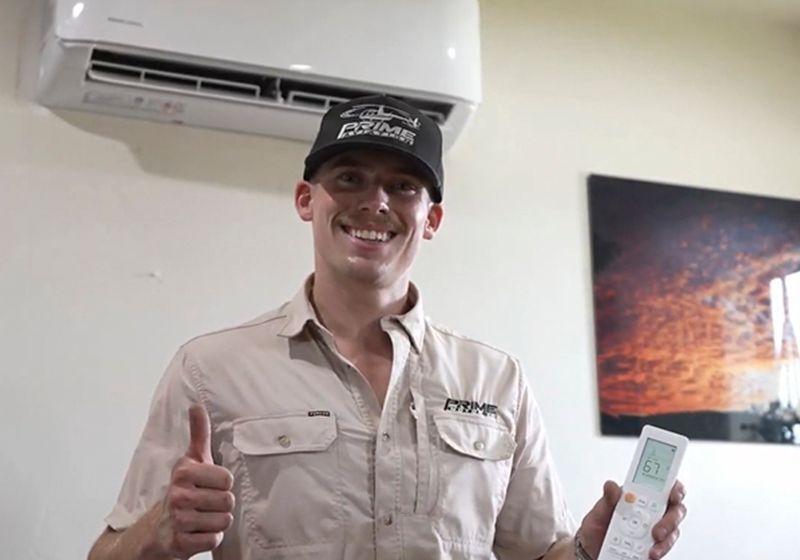
For homes this remote, Noah points out, hiring a traditional HVAC contractor isn't simple or cheap, if you can find one willing to make the drive at all.
It's a no-brainer to go with a DIY® system and make it easy for yourself," he says, "so you don't have to deal with getting contractors out to charge the system or install it.
In an off-grid home, cooling efficiency (23.6 SEER2 rating for Matthew’s 9K unit) directly affects the household's available energy supply. Because Matthew's home relies entirely on solar-generated electricity, reducing the energy required to maintain comfortable indoor temperatures was an important consideration when choosing the replacement system.
Matthew noticed the difference immediately. He can dial his room down to exactly as cold as he wants, and the family has made it clear how much they love it, especially for sleeping through hot Hill Country nights.
https://media.mrcool.com/Blog/Noah_Shaw/Noah_Shaw_Helicopter/media_1080p_3000k.m3u8
Can You Run a Mini-Split on Solar Power?
A MRCOOL® mini-split can run on solar power when it is connected to a properly designed solar electrical system that can meet the unit’s voltage and power requirements. MRCOOL® specifically notes that some customers pair the energy-efficient operation of DIY® Mini-Splits with alternative energy sources such as solar power for off-grid applications.
Because MRCOOL® mini-splits are electrically powered heat pumps, solar panels, batteries and an appropriately sized inverter can supply the electricity needed to operate the system. The exact solar setup will depend on the mini-split’s capacity and electrical requirements, as well as available sunlight, battery storage and other electrical loads in the home.
MRCOOL® has also documented real-world solar applications, including a DIY® 5th Generation Mini-Split installed in a solar-powered greenhouse for Jared Capp in South Dakota, where the system’s variable-speed inverter helps maintain consistent temperatures while operating efficiently.
For an off-grid home, it’s important to size both the mini-split and solar electrical system appropriately and follow the unit’s electrical specifications and local codes. MRCOOL® recommends having electrical work performed by a licensed electrician.
Three DIY® Mini-Splits for a Bandera Community Center
Not long after, Noah took on a very different kind of project. In Bandera, also known as the "Cowboy Capital of the World," a local man consistently recognized for his generosity had donated a building to serve as a new community fellowship center, a future gathering place for meals, worship, and events. Before the trim and paint could go on, though, the building needed a way to handle extreme summer heat.
Other technicians had quoted the job at $20,000–$30,000 to install the three mini-splits (price includes units and labor). A separate quote for a traditional central HVAC system came in around $32,000. For a nonprofit trying to put every dollar toward its mission, that was a steep ask.
Noah had a better idea. He runs MRCOOL® units at his own office and uses just one to cool an entire 1,200 square-foot garage with standard insulation. The fellowship center's open layout, finished with spray foam, was an even stronger candidate, especially since there wasn't a practical way to run ductwork. So instead of billing for the work, Noah and his team donated the entire install, letting the ministry redirect that money elsewhere.
The scope was substantial: three 36,000 BTU units (the largest DIY® units MRCOOL® offers) with two serving one large room and one serving another.
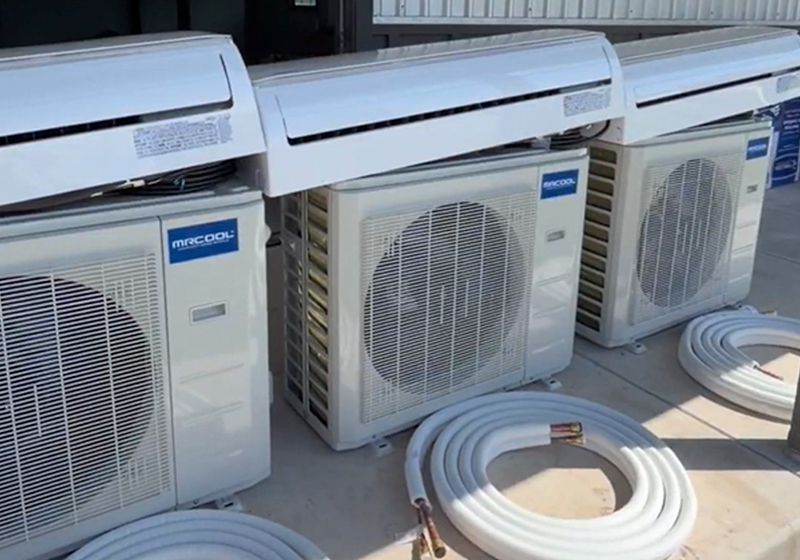
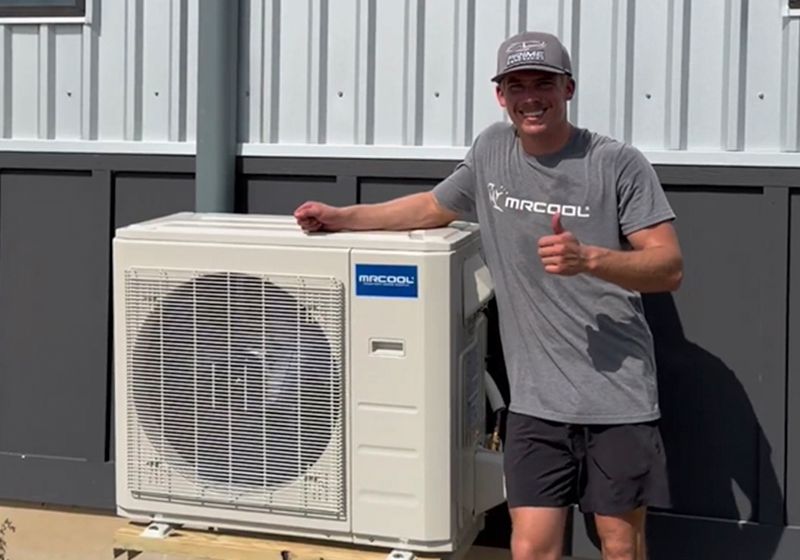
Starting around 10 a.m., Noah worked off scaffolding for the higher mounting points, traced out templates, and ran DIY® Quick Connect® line sets in a gray lineguard line set cover chosen to blend into the building. By 6 p.m., all three units were in. Electrical hookup and startup followed the next day, and the building had year-round comfort ready to go.
Noah brought a coworker along to help lift the units, and the day turned into an unplanned education. Watching Noah move through the install, his buddy came away impressed by how approachable the whole system was and left glad he'd been part of a project with a cause behind it.
How MRCOOL® DIY® Mini-Splits Simplify Installation
Two very different jobs, same result: comfort restored in a single day. Noah credits the DIY® 5th Gen design itself for making that kind of turnaround possible.
- The indoor unit template does most of the heavy lifting up front: mark the holes, level it, cut the hole, and mount the bracket. For Noah, that step alone takes 10 minutes or less.
- The pre-charged, quick-connect line set is, in his words, close to the best part of the whole kit. No vacuum pump and no brazing copper lines together. Just tighten the connections, test them, and move on.
- Final steps are as simple as hooking up the electrical and powering the system on.
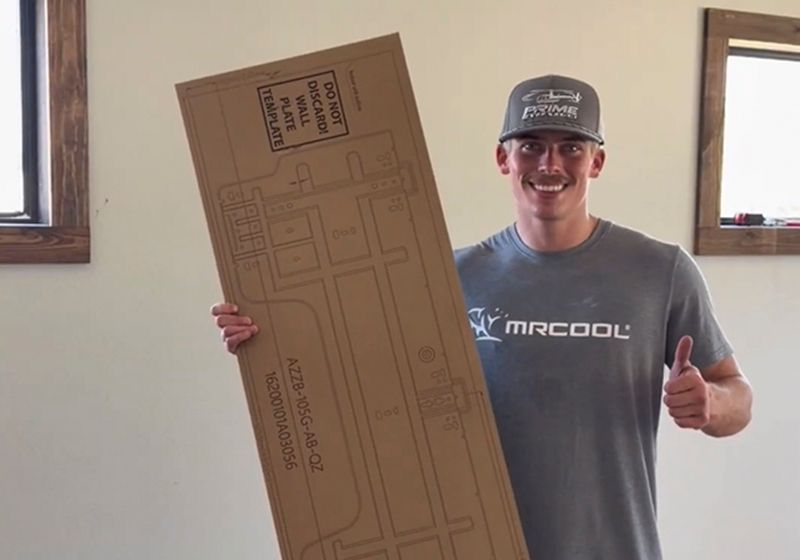
I would say I think I've installed over 15 of them (DIY® units) now, and I don't think I would install a traditional one ever again,” said Noah. “Once I've started installing y'all's DIY® units, it's the only thing I really want to install because of the simplicity, the price point, and the efficiency.
MRCOOL® DIY® Mini-Splits are designed for DIY installation using features such as pre-charged Quick Connect® line sets and an indoor-unit mounting template. Unlike conventional mini-split installations, the refrigerant line installation does not require vacuuming or brazing when installed according to the manufacturer's instructions.
Noah has installed older, non-pre-charged kits before, wrestling with vacuum pumps and soldered copper lines that turned a simple job into a much bigger project. The DIY® Quick Connect® line set removes that complexity entirely, which is exactly what let him swap out a full system on a remote hilltop in Medina before the day was out, and install three large units in a single day in Bandera.
https://media.mrcool.com/Blog/Noah_Shaw/Noah_3Zone_Church_Install/media_1080p_3000k.m3u8
Two Installs, Two Successful Outcomes
By the numbers, it was a summer of big BTUs and long rides. But for Noah, the two jobs point to something bigger than any single install. In Medina, it meant a young family didn't have to spend a brutal Texas summer without air conditioning. In Bandera, a donated system means a new community space can open its doors without an HVAC bill eating into its mission, a building expected to, as Noah puts it, "cool thousands and thousands of local people that are all there for a good reason."
Different circumstances, same outcome: comfort delivered fast, without complexity, to the people who needed it most. "That definitely makes it all worthwhile," Noah says. "For sure."
Looking for heating and cooling in a space where traditional HVAC isn't practical? Explore MRCOOL® DIY® Mini-Splits and find the right system for your home, garage, workshop or other hard-to-condition space.
Frequently Asked Questions
Can a mini-split run on solar power?
Yes, a mini-split can operate as part of a properly designed solar-powered electrical system, provided the system can meet the unit's voltage and power requirements. In Noah Shaw's Medina installation, the home operates completely off-grid using solar power, making HVAC energy consumption an especially important consideration.
Are mini-splits good for off-grid homes?
Mini-splits can be a practical option for some off-grid homes because they provide targeted heating and cooling without ductwork. System sizing and the home's available electrical capacity are especially important when the property relies on solar panels and battery storage.
Do MRCOOL® DIY® Mini-Splits require an HVAC technician?
MRCOOL® DIY® Mini-Splits are designed for DIY installation and use pre-charged Quick Connect® line sets that do not require vacuuming or brazing when installed according to the manufacturer's instructions. Electrical requirements and local codes still apply.
How long does it take to install a DIY® mini-split?
Installation time varies based on the property, system size, electrical work and installer experience. In these projects, Noah replaced one system within a few hours and installed three indoor/outdoor systems at the Bandera location in a single day before electrical hookup and startup the following day.