
Choosing the right HVAC system for a tiny home can be challenging. Limited space, energy efficiency, and noise all matter more in a 200–400 square foot home than they do in a traditional house. In this guide, Designer + Builder at Dogwood Dwellings (@dogwooddwellings) and cohost of HGTV's Worst Yard on the Block Margo Fairchild (@margo.does.stuff) explains why she chose a ductless mini-split for her 240-square-foot tiny home and what homeowners should consider before making the same decision.
Key Takeaways
- Mini-splits save valuable floor space.
- They are quieter than window AC units.
- Proper sizing improves efficiency.
- DIY-friendly options simplify installation.
- They work well for tiny homes and ADUs.
Why Build a Tiny Home?
With the rising cost of housing and utilities, limited real estate availability, and skyrocketing rent, many people are turning toward less conventional housing options. At the forefront of this movement is the tiny home. Tiny homes offer a compelling path to financial freedom, mobility, environmental friendliness, and a minimalist lifestyle, all with significantly lower maintenance.
Margo wanted all those things. So during the pandemic, she put her skills to the ultimate test and built her own tiny home from a shed shell.
From a Spice Rack to a 240-Square-Foot Dream
But Margo’s DIY journey didn't start with a full-blown house. It began back in 2018, thanks to a very lenient landlord and a desire to pick up power tools. She admits her early work wasn’t always pretty, but after poring over YouTube tutorials, she built enough confidence to create a spice rack. That small win snowballed into her next project: building a deck. Through trial and error, she learned how to tackle projects of varying sizes by taking them one step at a time.
Before breaking ground on her tiny home, Margo spent three years studying building science online. She compiled a massive research binder full of alternative dwelling inspiration, drawing ideas from skoolies, cob houses, earth homes, and other unconventional builds.
Tiny Home at a Glance
- Size: 240 sq. ft.
- Total Cost: $47,000
- HVAC: MRCOOL Advantage 12K
- Years Living There: 5
- Location: Richmond, VA
- Built From: Shed Shell
What Is the Best HVAC System for a Tiny Home?
For most tiny homes, a ductless mini-split is the best HVAC option because it delivers efficient heating and cooling, operates quietly, saves space by eliminating ductwork, and can significantly reduce energy costs compared to traditional systems.
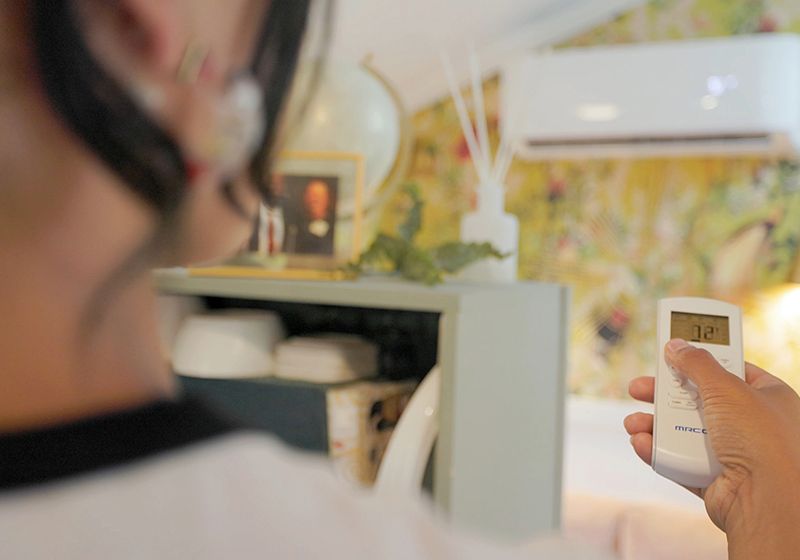
When Every Inch Matters: Installing a Mini-Split in a Tiny Home
In a tiny home, every single square foot matters. This makes choosing compact appliances and systems absolutely crucial for comfortable living. Heating and cooling a tiny home can be notoriously tricky; traditional central air is out of the question, and window units are loud, bulky, and take up valuable space.
Furthermore, in a 240-square-foot open layout, you are sleeping right next to your appliances, so you can hear everything.
To solve this, Margo had a MRCOOL® Advantage 12K Unit installed. Located directly above her living room sofa and adjacent to her bedroom, the unit is so incredibly quiet that she never has trouble hearing her television. In fact, as a self-appointed “white noise girly,” Margo actually had to bring in a separate fan and noise machine at night because the mini-split was too quiet.
The current 5th-Gen Advantage boasts a 52.5 dBA rating, which is comparable to steady rainfall or the quiet hum of a microwave. The other specifications can be found here.
How Much Electricity Does a Mini-Split Actually Use?
When outfitting your new tiny home or backyard ADU, maximizing energy efficiency is usually a top priority. So, how much electricity does a mini-split actually use? If you choose a ductless system like the MRCOOL Advantage, the answer is: significantly less than you might think.
Unlike traditional HVAC setups that aggressively blast on and off, the MRCOOL Advantage utilizes advanced inverter technology. This allows the system's compressor to continuously and smoothly adjust its output to match your indoor and outdoor temperatures. The result? It uses up to 30% less energy than a traditional system while maintaining much more consistent, reliable comfort.
Even better, going ductless is a massive energy saver on its own. According to the EPA and the Department of Energy’s Energy Star program, traditional homes lose 20% to 30% of their cooling power pushing air through leaky ductwork. Because a system like the MRCOOL Advantage doesn't require any intrusive, space-hogging ducts or vents, 100% of the air you pay to heat or cool is delivered directly into your living space.
By avoiding that 20-30% ductwork loss and utilizing smart inverter tech, upgrading to a ductless mini-split can lower your monthly operating costs by 30% to 40%. For a tiny home where square footage is highly limited, ductwork is financially impractical, and standard window AC units simply won't cut it, a ductless heat pump is the most efficient climate solution on the market.
Choosing a Mini-Split for a Tiny Home: Margo’s Choice
When it came time to pick her HVAC system in 2021, Margo didn't make the decision alone. Her mother, who recently retired after a long career as an intercompany HVAC liaison, helped her research units.
Here is why the MRCOOL® Advantage series was the clear winner:
- Industry Reputation: Her mother had heard incredible feedback from customers and contractors regarding the quality, ease of installation, and longevity of the MRCOOL® product line.
- Installation Practicality: The system is designed for professional installation, but its straightforward instructions made it fast and easy for the contractors she hired.
- Performance and Efficiency: Crucial for keeping utility costs low while providing reliable climate control.
Having done so much research over the years and seeing what other folks had installed in their tiny homes, it was a pretty easy decision. — Margo Fairchild
Installation Considerations for the MRCOOL® Advantage
One advantage of a ductless mini-split in a tiny home is its flexible outdoor installation. Unlike traditional HVAC systems that require extensive ductwork and mechanical space, the MRCOOL® Advantage Series uses a compact outdoor condenser that can be positioned on a level pad or mounted to an exterior wall, helping homeowners maximize every inch of their limited footprint.
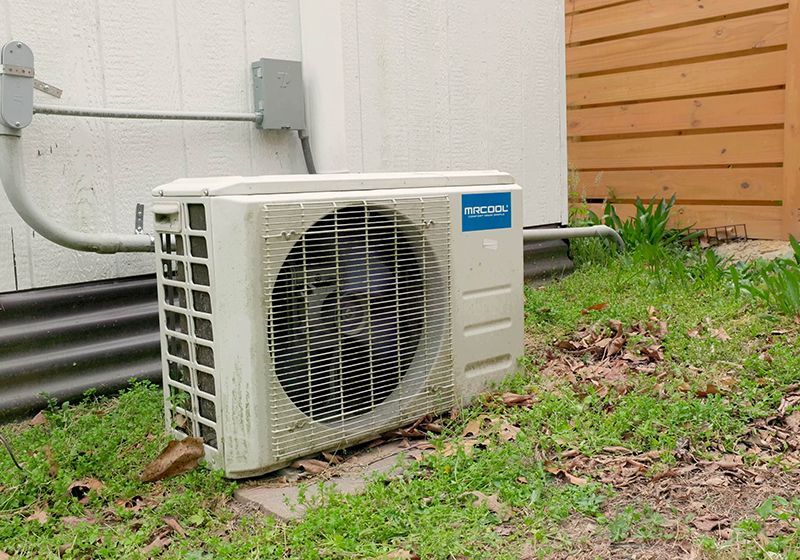
The indoor and outdoor units are connected by a pre-flared refrigerant line set, communication cable, and condensate drain, allowing the refrigerant and condensation to travel safely between the two components.
Because the Advantage Series is professionally installed, a licensed HVAC technician will ensure the system is properly connected to a dedicated electrical circuit, route the condensate drain for reliable water runoff, and position the condenser with adequate clearance for airflow and service access.
Once it’s set up, maintenance is minimal. Clean the indoor air filter regularly, keep the outdoor condenser free of leaves and debris, and periodically inspect the drain line to help the system operate efficiently year after year.
Designing for "Beholderism"
Aside from practicality, aesthetics were a major driving factor for Margo. She brings a philosophy of "beholderism" into her design, believing a space must be comfortable, cohesive, and uniquely you.
The MRCOOL® unit checked the aesthetic box effortlessly. Its sleek, modern design perfectly matched her home’s bright and bubbly vibe. To make the space even more seamless, Margo color-matched the wainscoting below her wallpaper to the crisp white of the air handler, tying the whole room together beautifully.
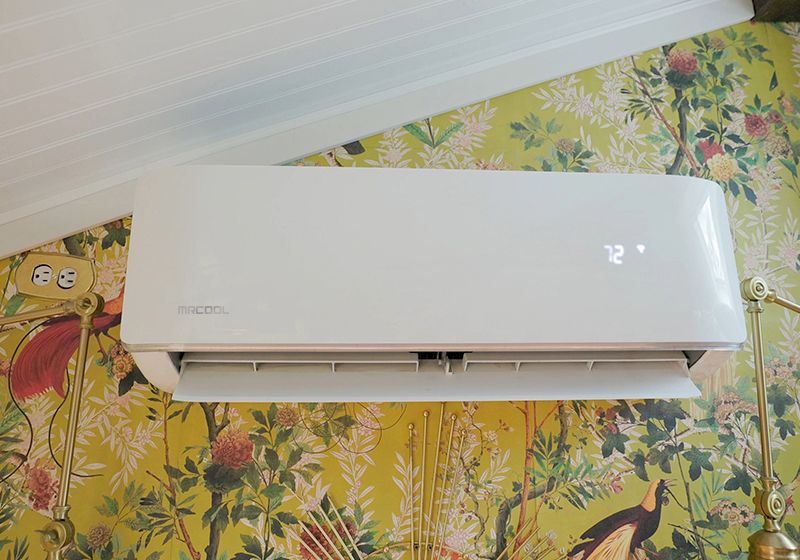
What's Next for Tiny Home Aesthetics? Design tastes evolve, and Margo notes that if she were to build her home all over again today, she would trade her bright space for something a bit more muted and moody. That's why she was thrilled to hear that MRCOOL® is unveiling a brand-new DIY® Select with a black air handler. It is the perfect solution for homeowners looking to cultivate a darker, moodier, and ultra-modern aesthetic in their own unique spaces.
Big News for Tiny Homes
While the aesthetics of a tiny home are always exciting to plan, the daunting permits and paperwork just got significantly easier in Virginia. With the recent passage of Senate Bill 531, the state has officially legalized Accessory Dwelling Units (ADUs) by-right across all single-family zoning districts in the commonwealth. If you’ve been dreaming of putting a tiny home in your backyard, figuring out how to efficiently heat and cool it with a ductless mini-split just became a much more immediate reality.
Taking effect on July 1, 2027, the law slashes red tape by introducing several major homeowner protections:
- By-Right Construction: Localities are now required to permit ADUs in all single-family zoning districts.
- Permit Fee Caps: Permit fees for ADUs are strictly capped at $500.
- Fair Setbacks: Localities are prohibited from enforcing setbacks for ADUs that are greater than those required for the primary dwelling or other accessory structures.
- No Relation Requirements: The law eliminates outdated rules that forced ADU occupants to be related to the primary homeowners.
Not only does this legislation create much-needed affordable housing, but it also allows homeowners the flexibility to easily generate rental income, house aging relatives, or expand their living space. With these massive zoning hurdles finally removed, Virginia is poised for a backyard building boom. Now is the perfect time to start planning your ADU's footprint and finding the right ductless mini-split system to keep your new tiny home perfectly comfortable year-round.
Five Years Later: Would Margo Choose the Same Mini-Split Again?
The choice to go ductless has already proven its worth. After relying on the system for five years, Margo notes the investment has more than paid for itself compared to what she was spending on rent before the pandemic.
The unit hasn't given her a single problem, keeping her space cozy in the winter and cool in the summer. Raving about its outstanding performance and overall reliability, she says she would make the exact same choice today, as the system has served her well for half a decade.
Ready to Build Your Own Comfort Zone?
Whether you're constructing a 240-square-foot tiny home from scratch or just upgrading the comfort of your current living room, you deserve quiet, efficient, and stylish climate control.
Explore the ductless mini-split lineup to find the perfect fit for your next DIY project, and be sure to keep an eye out for our all-new black air handler to match your boldest aesthetic visions!
Want more DIY inspiration? Follow Margo's adventures on Instagram @margo.does.stuff and tour her tiny home @TinyHomeTours
Before Buying a Mini-Split for Your Tiny Home
✔ Know your square footage
✔ Measure ceiling height
✔ Evaluate insulation
✔ Consider climate
✔ Decide between DIY or professional installation
✔ Choose the right BTU size
If you decide to go with a do-it-yourself system, use the MRCOOL® DIY® System Selector to help you make the right choice and check off all the boxes above.
Still have questions? Here are answers to some of the most common questions homeowners ask when choosing a mini-split for a tiny home.
Frequently Asked Questions
What size mini-split do I need for a 240-square-foot tiny home?
For a 240-square-foot tiny home, a 9,000 BTU mini-split is often a good starting point, but the right size depends on more than square footage alone. Insulation levels, ceiling height, window size, sun exposure, and your local climate all affect the heating and cooling load. MRCOOL® recommends using a professional load calculation for the most accurate sizing. In Margo Fairchild's case, she chose a 12,000 BTU MRCOOL® Advantage system based on her home's specific design and comfort needs.
Can I install a mini-split myself?
It depends on the model. MRCOOL®'s DIY® Series is specifically designed for homeowners, featuring pre-charged Quick Connect® line sets that eliminate the need for specialized HVAC tools. However, not every MRCOOL® system is DIY-friendly. For example, the Advantage Series in Margo's tiny home is intended to be installed by a licensed HVAC professional. Always follow the installation requirements for your specific model.
Are mini-splits worth it for ADUs?
Absolutely. Mini-splits are one of the most practical HVAC options for accessory dwelling units (ADUs). Since most ADUs are compact, ductwork often isn't practical or cost-effective. A ductless mini-split provides efficient year-round heating and cooling, preserves valuable interior space, and gives occupants independent temperature control. As more homeowners build ADUs, mini-splits continue to be a popular solution because they're efficient, flexible, and well suited to smaller living spaces.
Do tiny homes need ductwork?
No. One of the biggest advantages of a ductless mini-split is that it doesn't require traditional ductwork. This saves valuable interior space while avoiding the energy losses commonly associated with ducts. According to the U.S. Department of Energy, homes with forced-air systems can lose 20% to 30% of conditioned air through duct leaks. By delivering heated or cooled air directly into the living space, ductless mini-splits provide an efficient and space-saving solution that's especially well suited for tiny homes and ADUs.